Published May 10, 2023 | Last updated August 2026
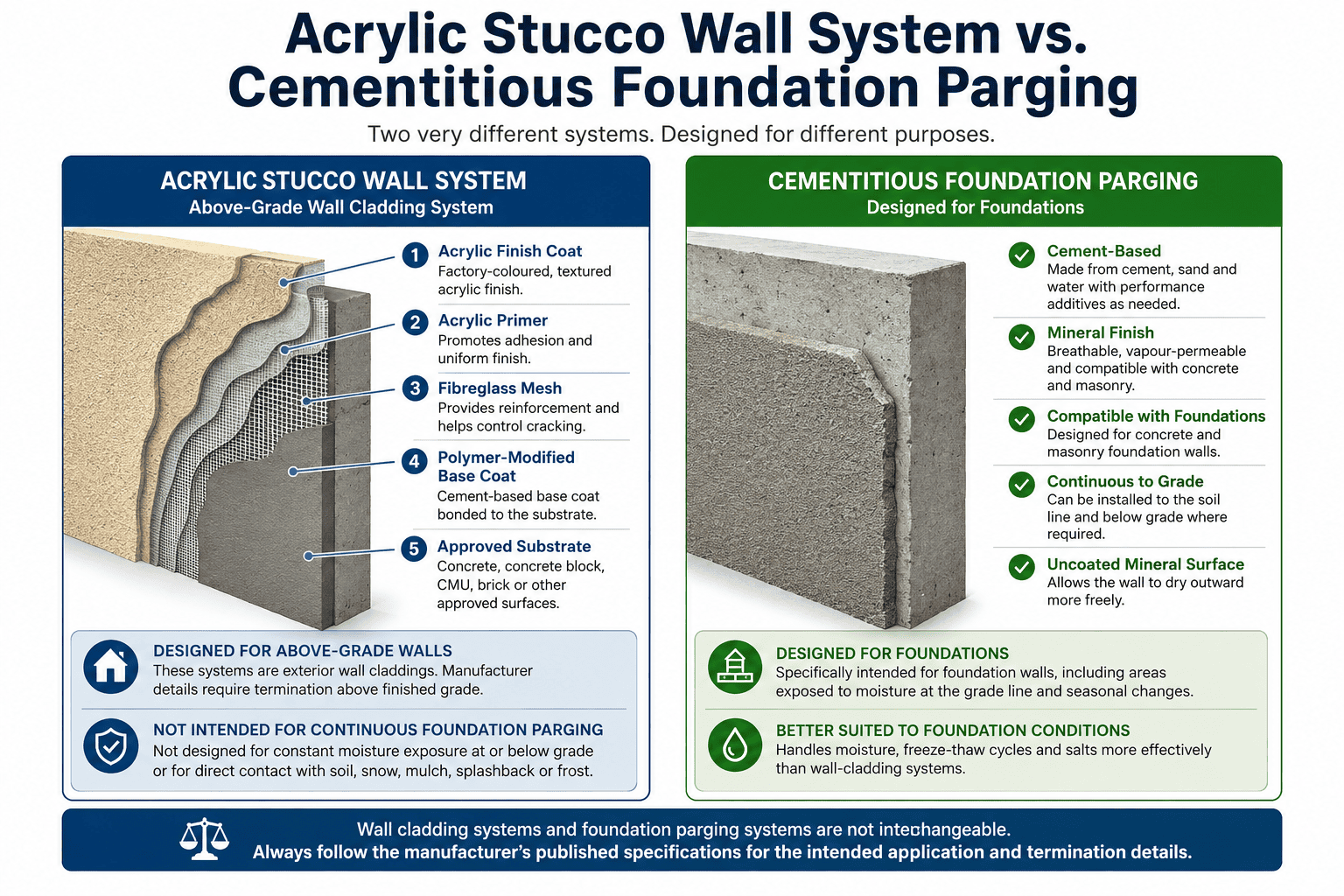
The term “acrylic parging” is commonly used by contractors, but it usually does not describe a dedicated foundation-parging product. In most cases, it refers to an acrylic stucco or exterior wall-cladding system being applied over a foundation and marketed as an alternative to traditional cementitious parging.
Acrylic stucco systems can provide integral colour, manufactured texture, fibreglass reinforcement, lower surface-water absorption and improved flexibility in the above-grade wall applications for which they are designed. The concern begins when that wall-cladding assembly is extended down a conventional concrete or masonry foundation to the soil line and sold as “parging.”
Standard acrylic stucco systems are generally not designed for use at or below finished grade on conventional concrete and masonry foundations, including poured concrete, concrete block and brick. The manufacturer information reviewed for this guide distinguishes acrylic exterior wall systems from products specifically intended for foundation parging.
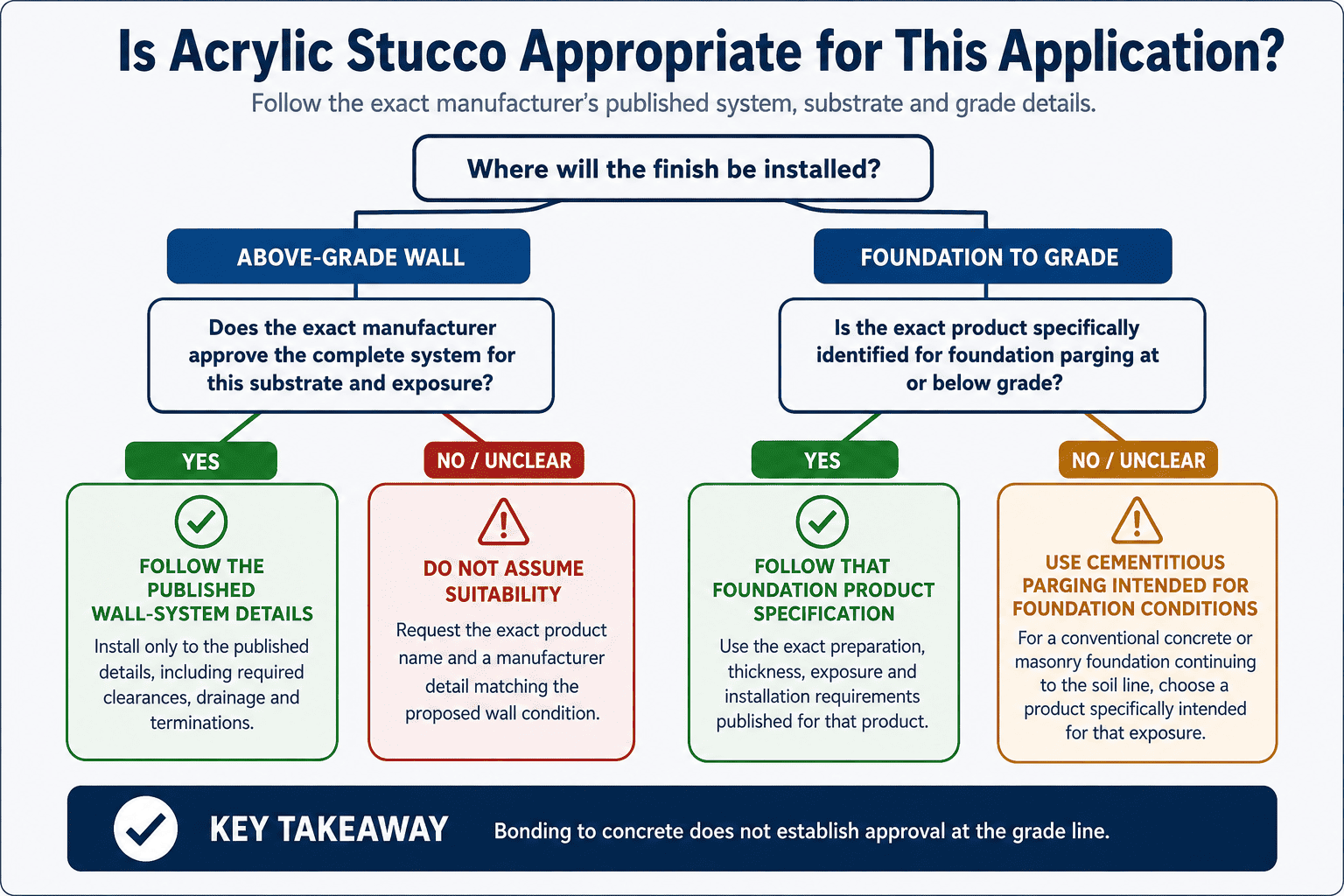
Acrylic stucco can be appropriate on an approved above-grade wall assembly when it is installed according to the exact manufacturer’s system details.
For conventional foundations that continue to the soil line, J and J Coatings recommends cementitious parging selected for foundation exposure.
Some homeowners still prefer acrylic because of its colour and manufactured texture options. If you understand the trade-offs and still choose acrylic, J and J Coatings can provide acrylic parging on request after reviewing the application details.
- Approval over concrete or block is not the same as approval for foundation parging at the soil line.
- The reviewed acrylic wall systems either require clearance above finished grade or do not provide a published foundation-grade detail.
- ADEX PARGEX Mix, the reviewed product specifically identified for concrete foundations and block walls above and below grade, is cement-based.
What does “acrylic parging” actually mean?
The phrase “acrylic parging” can be misleading. Parging traditionally refers to a cementitious coating applied to concrete or masonry. Acrylic stucco, by comparison, is generally a layered exterior wall-finish system that may include a polymer-modified base coat, fibreglass reinforcing mesh, primer and a factory-coloured acrylic finish.
Applying that wall system over a foundation does not turn it into a dedicated foundation-parging product. Different contractors may also use the phrase “acrylic parging” for different combinations of products.
The difference is not merely cosmetic. Product composition, film formation, finished thickness, drainage details, vapour transmission and approved exposure conditions all affect where a system should be installed.
A contractor should therefore identify the exact manufacturer, product and complete assembly. Descriptions such as flexible, waterproof, breathable or mesh reinforced do not establish that a system is approved for foundation exposure at the grade line.
Why acrylic can sound superior in a sales presentation
Acrylic systems are easy to market because their benefits are visible and simple to describe. They are available in many colours and manufactured textures. Reinforcing mesh can be shown to the homeowner. Flexibility can be demonstrated by bending a sample, and the finished surface can look consistent immediately after installation.
Those advantages are real within the correct application. A factory-coloured acrylic finish avoids the need to paint the parging. Mesh reinforcement can improve resistance to minor cracking, and polymer modification can improve adhesion and flexural performance. An acrylic wall system can be an excellent choice for an above-grade architectural wall.
The problem is the word superior. A material is not superior in every location simply because it has more flexibility, more colour choices or lower surface-water absorption. Foundation parging must also tolerate grade-line exposure, release moisture, remain practical to repair and comply with the manufacturer’s intended use.
A high-performance wall-cladding product can therefore be less suitable than a simpler cementitious product at the foundation. The correct material is the one designed for the conditions, not necessarily the one with the longest list of marketing benefits.
Homeowners should also distinguish between a complete tested wall system and a contractor-created combination of products. Manufacturers evaluate named assemblies with specific substrates, layers, thicknesses and termination details. Substituting components or extending the system into a different exposure condition may change its performance and warranty eligibility.
A concrete or block substrate is not the same as a foundation application
This distinction is especially important when discussing ADEX DIREX. The current DIREX specification describes a barrier cladding for direct application over cementitious substrates such as concrete block, precast concrete or masonry walls. It also describes DIREX as a coating system for exterior concrete, masonry or stucco walls.
That tells the designer which wall surfaces may accept the coating. It does not state that DIREX is a foundation-parging system, approve soil contact, provide a below-grade application, or publish a detail for continuous installation to the grade line on a foundation.
Concrete block and precast concrete are used throughout above-grade construction. A product can be suitable over those substrates on an exterior building wall while remaining unsuitable for the moisture and exposure conditions at the base of a foundation.
In the absence of a manufacturer-published foundation detail, J and J Coatings treats DIREX as an above-grade wall coating and does not recommend extending it to or below finished grade as continuous foundation parging.
What major manufacturers actually publish
The table below compares the stated application and grade guidance for several well-known acrylic wall systems and one dedicated foundation-parging product. It is not a claim that every product made by these companies has identical requirements. It compares the specific published systems listed.
The overall pattern is consistent: acrylic systems are presented as exterior wall claddings and either require clearance above grade or do not provide a published foundation-grade approval. The product expressly designed for concrete foundations and block walls at and below grade is cementitious.
| Product/system | Intended application | Grade-line guidance | Moisture and warranty relevance |
|---|---|---|---|
| ADEX DIREX | Direct-applied acrylic barrier cladding for exterior cementitious walls such as CMU/block, precast concrete and masonry. | No published approval as continuous foundation parging at or below grade. J and J recommends treating it as an above-grade wall coating and terminating it above grade. | Five-year materials warranty excludes consequences of poor foundation drainage, deficient waterproofing or sealants, and water leaks or infiltration. Remedy is limited to replacement material. |
| ADEX-RS | Water-managed exterior insulation and finish wall-cladding system. | Published termination detail requires a minimum 203 mm (8 inches) above finished grade. | Uses a separate drainage and weather-resistive assembly. It is not identified as foundation parging to the soil line. |
| DuROCK PUCCS LRRC | Continuous-insulation rainscreen cladding for residential and low-rise exterior walls. | Manufacturer specification requires termination and drainage at least 200 mm (8 inches) above finished grade. | Includes a water-resistive barrier and drainage accessories. Warranty depends on installation to the published specification. |
| Dryvit Outsulation MD | Exterior insulation and finish wall system with air/water barrier and drainage. | Application instructions require the system to be held at least 203 mm (8 inches) above finished grade. | Designed as a drained wall assembly, not as a continuous acrylic foundation finish at the soil line. |
| StoTherm ci over masonry | Exterior continuous-insulation wall cladding over concrete masonry. | Requires at least 152 mm (6 inches) above finished grade and more clearance in snow regions. | Sto shows separate cementitious damp-proofing or waterproofing below the wall-system termination. |
| ADEX PARGEX Mix | Preblended cement-based parging for concrete foundations and block walls. | Specifically described for use above and below grade. | A dedicated foundation product mixed with water, not a factory-coloured acrylic wall finish. |
Note: The DIREX specification does not state a numerical grade clearance. The recommendation to terminate it above grade is J and J Coatings’ professional conclusion based on its published wall-cladding use and the absence of a foundation-parging or at/below-grade detail.
Official manufacturer and evaluation sources
- ADEX DIREX system specification, September 2025
- ADEX-RS termination-at-grade detail
- ADEX PARGEX Mix technical bulletin
- ADEX five-year limited materials warranty
- CCMC 12913-R evaluation for ADEX systems
- DuROCK PUCCS LRRC manufacturer specification, June 2026
- DuROCK PUCCS LRRC termination-at-grade detail
- Dryvit Outsulation MD application instructions
- StoTherm ci over concrete masonry termination-at-grade detail
Why the grade line is different from an above-grade wall
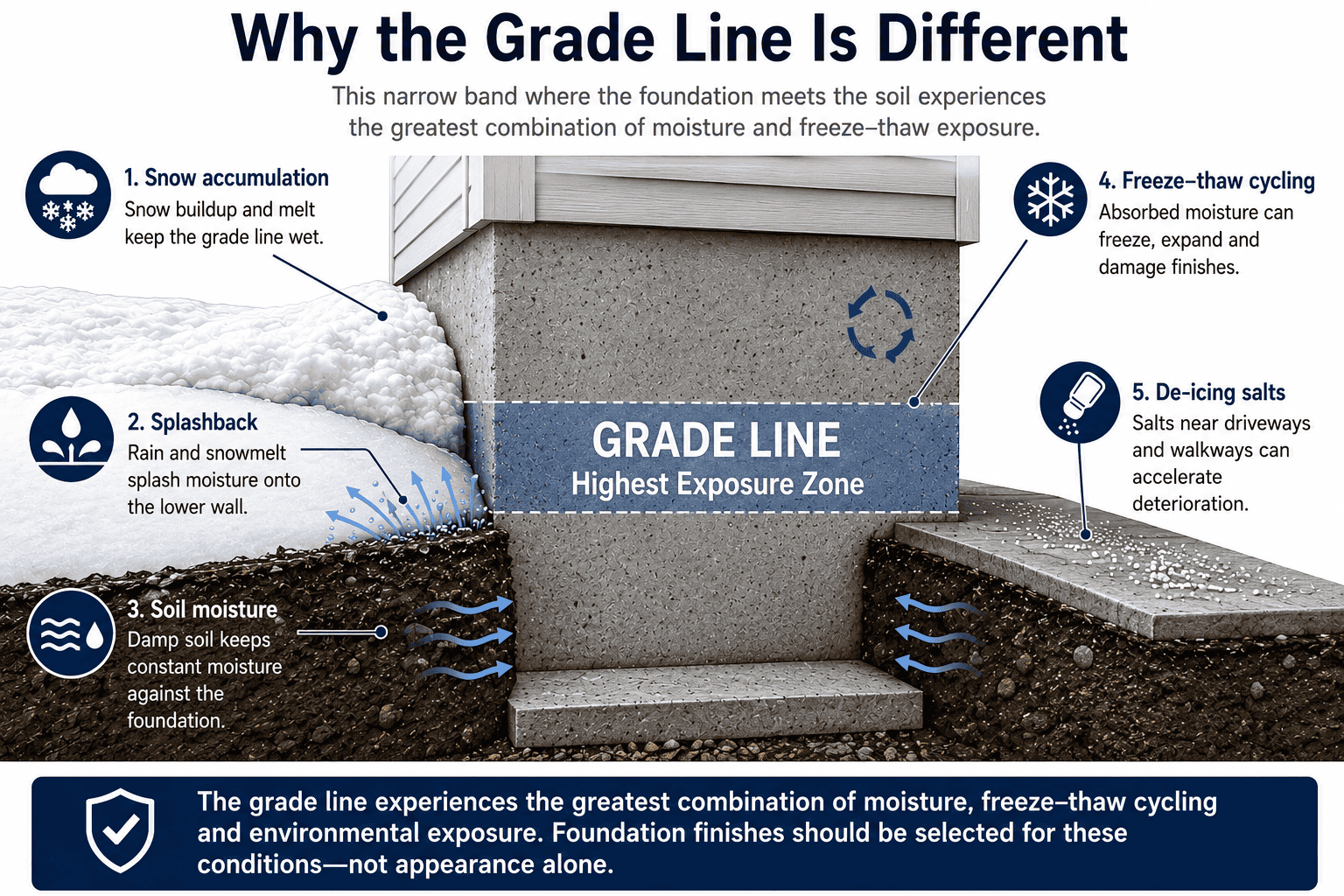
The bottom of a foundation experiences more severe and persistent moisture exposure than a typical above-grade wall. Soil, mulch and landscaping can remain damp against the surface. Rainwater splashes upward. Irrigation repeatedly wets the lower wall. Snow can accumulate for months and then release moisture during spring melt.
Edmonton foundations also experience repeated freeze-thaw cycles. Water near the surface can freeze, expand and thaw while the wall is exposed to changing temperatures. Driveways, sidewalks and steps may introduce de-icing salts, and frost movement can create stresses where the foundation meets adjacent flatwork.
A system designed as above-grade wall cladding is normally kept away from these conditions by a published clearance and termination detail. Extending that same acrylic assembly to the soil line removes the clearance the manufacturer uses to separate the wall system from foundation exposure.
This does not mean cement parging is waterproof or immune to movement. It means a cementitious foundation product is intended to function as the exposed finish in that location, while the reviewed acrylic wall systems are not.
Comparing acrylic and cement parging for your home?
Send photos showing the foundation, grade line and transitions to siding or stucco. We can tell you what we would recommend for that specific foundation and provide a written quote for the system we recommend. We also offer acrylic parging in Edmonton on request for homeowners who prefer the colour and texture options after understanding the trade-offs.
Acrylic may be vapour permeable, but it does not dry as freely as cement parging
Some acrylic manufacturers accurately describe their products as vapour permeable. Vapour permeable does not mean the surface dries as freely as an uncoated cementitious parge coat. It simply means a measured amount of water vapour can pass through the tested material or assembly.
An acrylic system adds polymer-rich base materials, primer and a factory-coloured finish layer. Each additional layer contributes vapour resistance. Moisture that enters the foundation or parging from behind must pass through the complete assembly before it can dry outward.
The Canadian Construction Materials Centre evaluation for ADEX systems provides a useful measured comparison. It reports water-vapour transmission of 344 ng/(Pa·s·m²) for ADEX Basecoat alone and 101 ng/(Pa·s·m²) for the lamina consisting of ADEX Basecoat with ADEX Finish. In that tested assembly, adding the finish reduced vapour transmission by approximately 71 percent.
ADEX Basecoat is itself polymer modified, so this test is not a direct laboratory comparison with every conventional cement-parging mix. It does, however, demonstrate the central point: a surface can remain technically vapour permeable while the acrylic finish substantially reduces its outward drying rate.
At the bottom of a foundation, where moisture exposure is highest, that reduction matters. Cementitious parging without an acrylic finish film generally provides greater drying potential and is more compatible with the moisture behaviour of concrete and masonry.
Water resistance and drying are not the same thing
Acrylic finishes are often promoted as water resistant. Lower surface-water absorption can help an above-grade wall shed rain and resist staining. It does not mean the assembly should remain in contact with damp soil, accumulated snow or prolonged moisture at the base of a foundation.
Water can also reach the finish from behind. Concrete and masonry contain moisture and can transmit it toward the exterior. Moisture may enter through cracks, joints, the top of the parging, adjacent landscaping or an imperfect transition. Once behind a less-permeable finish, that moisture may take longer to escape.
This is why water resistance and breathability must be evaluated together. A coating that resists liquid water from the front can still reduce drying toward the exterior. That trade-off may be acceptable in a designed drained wall system that includes flashing, a water-resistive barrier, drainage space and deliberate terminations. It is less convincing when the same finish is simply extended to the soil line as parging.
Cementitious parging is not a waterproof membrane, but it is more forgiving as an exposed mineral finish. It can absorb and release moisture without an acrylic film forming the final exterior layer. Proper grading and foundation waterproofing remain essential, yet the parging itself does not unnecessarily restrict outward drying.
The goal is not to trap a foundation behind a coating and hope no moisture ever enters. The goal is to use a compatible finish that can tolerate normal wetting and drying while remaining serviceable in Edmonton’s climate.
Flexibility does not make acrylic suitable for every location
Acrylic and polymer-modified materials can be more flexible than conventional cement finishes. Fibreglass mesh can also distribute minor surface stresses and improve some forms of impact resistance. Those advantages should be acknowledged.
Flexibility is only one performance characteristic. It does not create manufacturer approval for soil contact or below-grade exposure. It does not prevent failure caused by moisture behind the finish, poor drainage, inadequate preparation, structural movement, frost heave or an improperly detailed termination.
A flexible finish can still blister, delaminate, puncture or crack when the complete assembly is used outside its intended exposure. Conversely, properly prepared cementitious parging can perform for decades on a stable foundation, even though it is more rigid.
The correct comparison is therefore not simply flexible versus rigid. The correct question is whether the selected system is designed for the substrate, grade condition, moisture exposure and repair requirements of the foundation.
What the ADEX warranty says about moisture-related problems
A warranty should not be confused with approval for a particular installation. The five-year ADEX limited materials warranty that lists DIREX requires installation in strict accordance with the latest ADEX documentation and specifications.
The warranty excludes consequences resulting from poor drainage around foundation walls, defects or insufficiency in waterproofing or sealants, and water leaks or infiltration. It also excludes improper installation and application, deficiencies in the wall structure, and damage considered purely aesthetic.
If ADEX determines that a covered material is defective, the stated remedy is replacement material. The warranty does not pay for demolition, renovation, removal or labour required to install replacement materials.
These exclusions are especially relevant near grade because moisture, drainage, waterproofing and installation detailing are the most likely sources of a foundation-coating problem. A contractor’s separate workmanship warranty may provide additional protection, but it is not the same as the manufacturer’s limited materials warranty.
Thickness, impact damage and future repairs
Acrylic wall systems and cementitious foundation parging also differ in how they are built and repaired. A typical direct-applied acrylic finish consists of a relatively thin base layer, optional or specified fibreglass mesh, primer and a finish coat whose thickness is generally controlled by the aggregate in the texture.
A properly installed cementitious parge coat can be built as a more substantial mineral layer. Finished thickness depends on the product, substrate and number of coats, but the system is not limited to a thin decorative acrylic film. This can provide a robust surface for the normal contact that occurs around foundations.
No finish is impact proof. Acrylic systems can be upgraded with heavier meshes, while cementitious parging can be reinforced at cracks, transitions or non-masonry substrates. The practical issue for homeowners is what happens after a shovel, trimmer, landscaping tool or moving object damages a small area near the ground.
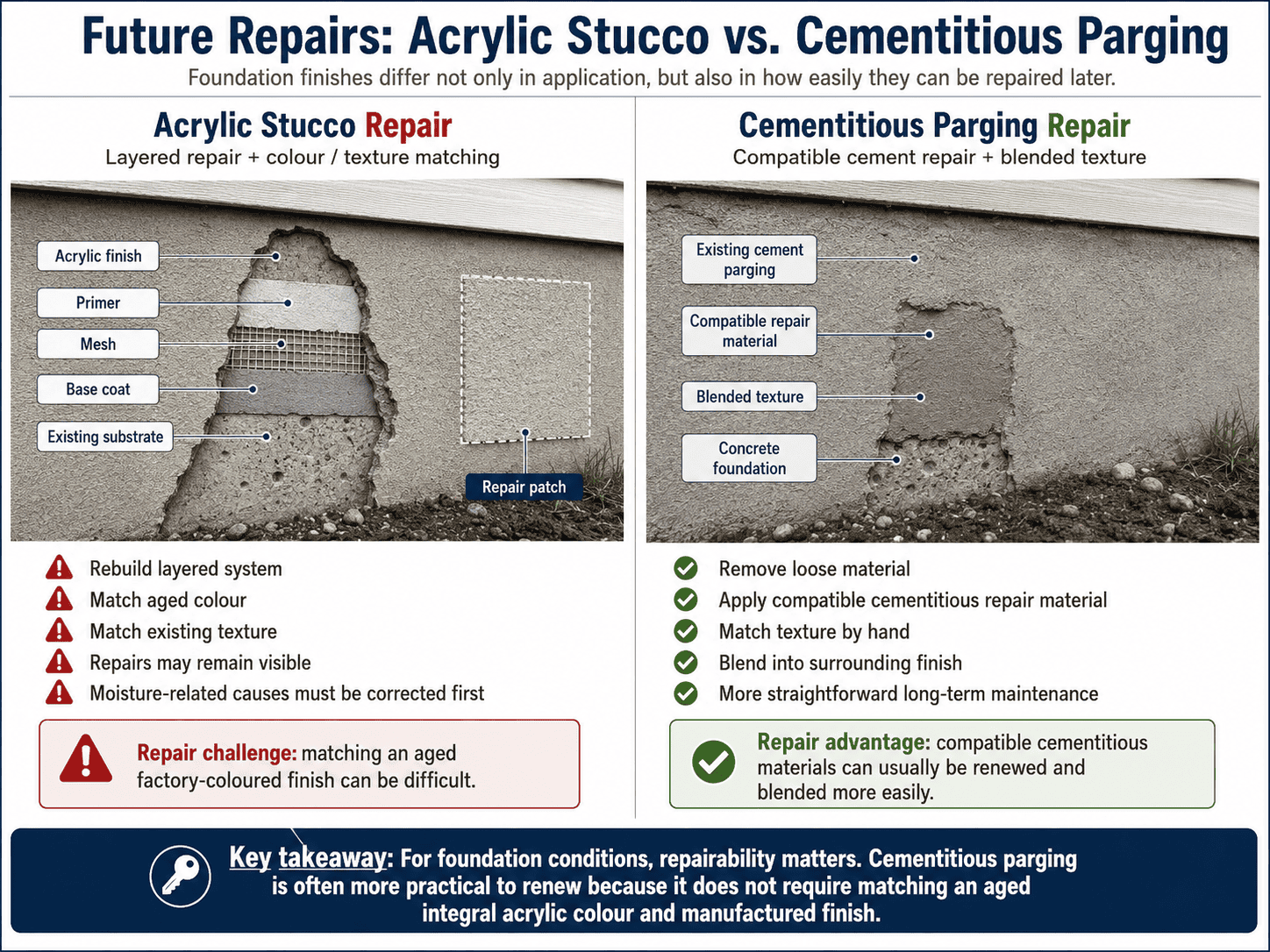
A localized acrylic repair may require rebuilding the mesh and finish layers and then matching a colour and texture that have weathered for years. Even when the repair is technically sound, the patch can remain visible. With cementitious parging, compatible repair material can usually be textured and blended without reproducing an integral factory colour.
This does not make every cement repair invisible, and workmanship still matters. It does make the long-term maintenance process more straightforward for a foundation finish that may eventually need localized renewal.
Why dedicated foundation products are cementitious
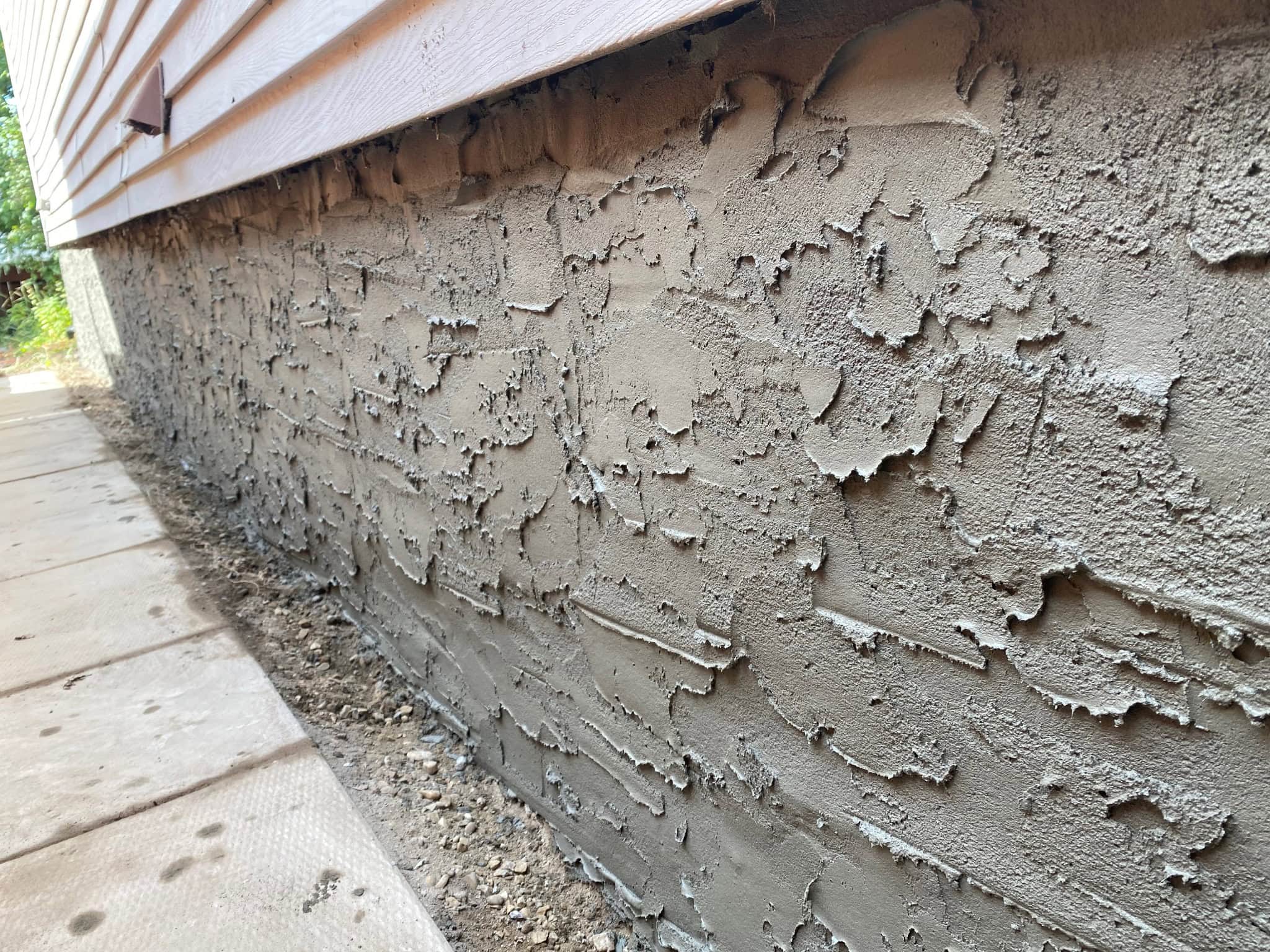
ADEX PARGEX Mix provides a useful comparison within the same manufacturer’s product line. ADEX describes PARGEX as a preblended, ready-to-use coating specially designed to parge concrete foundations and block walls. The bulletin expressly states that it may be used above and below grade.
PARGEX is mixed with water and finished as a cementitious parge coat. It is not the coloured acrylic finish used in DIREX or ADEX-RS. That distinction shows that ADEX itself separates exterior acrylic wall claddings from a dedicated cement-based foundation product.
The same logic applies more broadly. When a manufacturer intends a product for foundation parging, the documentation normally says so and provides relevant surface preparation, thickness and exposure guidance. Homeowners should not have to infer foundation suitability from a general statement that a wall coating can be applied over concrete or block.
Why J and J Coatings recommends cementitious parging
For conventional foundations that continue to the soil line, J and J Coatings recommends a properly selected cementitious foundation parging system rather than standard acrylic stucco.
Concrete, concrete block, brick and cement parging are mineral-based materials. With the correct surface preparation and bonding method, cementitious parging can become a compatible protective and decorative finish on the exposed foundation.
It can also create a continuous appearance down to the grade line without introducing an acrylic termination several inches above the ground or relying on a wall-cladding detail that was not designed for the foundation condition.
Cementitious parging provides greater outward drying potential because it does not add a factory-coloured acrylic finish layer. It is also more practical to repair in the future. A cement repair can be completed using compatible materials without attempting to reproduce an aged integral colour and manufactured acrylic texture.
A proper cementitious parging installation is not a thin cosmetic skim. Depending on the existing condition, the work may include removal of loose or damaged material, cleaning and preparation, suitable bonding materials, reinforcement of cracks or transitions where required, application at an appropriate thickness, consistent finishing and controlled curing.
No parging system can stop structural movement or replace foundation waterproofing. Drainage problems, active leaks and structural cracks must be addressed separately. The purpose of choosing the correct parging material is to provide a durable exposed finish that suits the normal conditions at the foundation.
- Compatible with concrete and masonry foundation substrates.
- Can provide one continuous exposed finish to the grade line when the selected mix is intended for that exposure.
- Allows greater outward drying than an acrylic-coated assembly.
- Can be repaired with compatible cementitious materials without matching integral acrylic colour.
- Avoids using an above-grade wall-cladding product outside its published application.
How to read a manufacturer specification
Technical documents can appear to approve more than they actually do. A list of related specification sections may mention cast-in-place concrete or unit masonry because those materials occur elsewhere in the building assembly. That is not the same as a statement that the finish is intended for foundation use at grade.
Start with the system description. Does the manufacturer call the product an exterior wall cladding, a coating for exterior walls, or a foundation-parging product? Then review design requirements and termination details. Look for a specific finished-grade dimension and determine whether the visible finish stops above grade.
Next, review the product bulletin for limitations and the warranty for exclusions. Water-resistive, waterproofing and drainage components may be shown as separate parts of the wall assembly. Their presence does not turn the decorative acrylic finish into below-grade waterproofing.
Finally, make sure the document matches the product actually being proposed. A contractor should not use an ADEX-RS drawing to justify DIREX, a residential rainscreen detail to justify a direct-applied coating, or a product approved over block to claim approval for a block foundation at the soil line.
The most reliable evidence is a manufacturer document that names the exact system, substrate and grade condition. When that document is absent, homeowners should not be asked to rely on a general claim that the material is flexible or can be applied to concrete.
Questions to ask before accepting an acrylic foundation quote
A proposal may use the phrase acrylic parging without identifying the complete product or system. Before choosing it for a foundation, ask the contractor to answer the following questions in writing.
- What is the exact manufacturer and product name for the base coat, mesh, primer and finish?
- Does the manufacturer describe the system as foundation parging, or only as exterior wall cladding?
- Can the contractor provide a published detail for the exact condition at finished grade?
- Does that detail apply to a conventional concrete or masonry foundation, rather than a different wall assembly?
- How far above grade must the system terminate?
- What does the manufacturer’s warranty exclude regarding drainage, waterproofing and water infiltration?
- Does the manufacturer cover labour and removal, or only replacement materials?
- How will future repairs be completed if the integral colour and texture have weathered?
What if acrylic stucco is already installed on the foundation?
An existing acrylic coating does not automatically mean that immediate failure will occur. Performance depends on the exact products, preparation, drainage, exposure, workmanship and condition of the substrate.
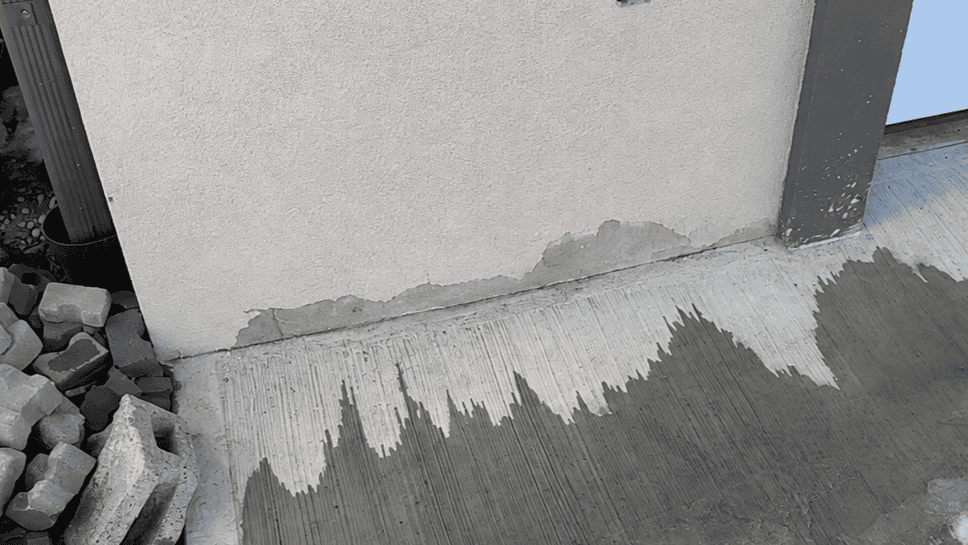
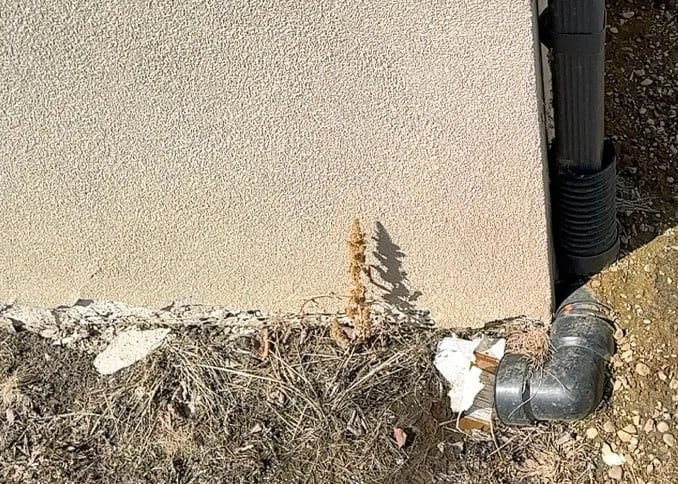
Inspect the lower wall for peeling, blistering, cracking, punctures, bulging, staining, efflorescence, hollow areas or separation. Pay particular attention to locations where soil, mulch, snow or irrigation water remains against the coating.
Do not simply apply another acrylic coat over a damaged area without identifying the cause. The correct repair may involve removing loose material, improving drainage, correcting the grade, addressing moisture or replacing the exposed foundation finish with cementitious parging.
Where an active leak, structural crack or below-grade waterproofing problem is present, parging alone is not the solution. Those concerns should be referred to the appropriate waterproofing or structural professional.
Our recommendation for Edmonton foundations
Standard acrylic stucco systems have legitimate uses on above-grade exterior walls. They can provide colour, texture, flexibility and architectural design options when installed as part of the manufacturer’s intended wall assembly.
They should not be re-labelled as superior foundation parging simply because they can adhere to concrete or block. The reviewed manufacturer literature shows that major acrylic wall systems are kept above finished grade, while the direct-applied DIREX specification does not provide foundation-parging approval at or below the grade line.
For exposed foundations that continue to the soil line, cementitious parging remains our recommended choice. It is the material category specifically identified for foundation use, it provides greater drying potential, and it creates a practical continuous finish that can be maintained and repaired over time.
Every project should still be assessed individually. Existing coatings, substrate condition, cracks, access, drainage, landscaping and previous repairs can all affect the recommended scope.
If a homeowner understands these concerns and still prefers the colour and texture of acrylic, we can provide acrylic parging on request after reviewing the proposed application.

See more completed Edmonton parging projects.
Frequently asked questions
Is acrylic stucco suitable for a foundation?
Standard acrylic wall systems are generally not recommended at or below grade on conventional foundations. Some may bond to concrete or masonry above grade, but that does not establish approval for continuous foundation parging to the soil line.
Can ADEX DIREX be applied over concrete block?
Yes. The DIREX specification lists cementitious substrates such as concrete block, precast concrete and masonry walls. That is substrate approval for an exterior wall coating, not specific approval as foundation parging at or below grade.
Does ADEX DIREX have to terminate above grade?
The DIREX specification does not publish a numerical grade clearance. It also does not identify DIREX as foundation parging or provide an at-grade or below-grade foundation detail. J and J Coatings therefore recommends treating it as an above-grade wall coating and terminating it above grade.
How far above grade do major acrylic wall systems terminate?
The reviewed ADEX-RS, DuROCK PUCCS LRRC and Dryvit Outsulation MD documents require approximately 203 mm, or 8 inches, above finished grade. StoTherm ci requires at least 152 mm, or 6 inches, and recommends more clearance in snow regions.
Is acrylic stucco breathable?
Some acrylic finishes are vapour permeable, but they do not breathe as freely as uncoated cementitious parging. In the CCMC ADEX test, adding ADEX Finish to ADEX Basecoat reduced measured vapour transmission by approximately 71 percent.
Is acrylic parging waterproof?
A standard acrylic finish is not a substitute for foundation waterproofing. Drainage, grading, weeping tile, sealants, structural crack repairs and below-grade membranes perform separate functions.
Is acrylic more flexible than cement parging?
Acrylic and polymer-modified systems can be more flexible and may resist some minor surface cracking. Flexibility does not make a wall-cladding system suitable at grade or protect it from moisture behind the finish, structural movement or installation outside the manufacturer’s details.
What does the ADEX warranty cover?
The 30-year transferable warranty is a limited materials warranty. It requires installation according to ADEX specifications and excludes poor foundation drainage, deficient waterproofing or sealants, water leaks and infiltration, improper installation and various substrate or structural conditions. The remedy is limited to replacement materials, not labour or removal.
Is cement parging waterproof?
No. Cementitious parging is a protective and decorative foundation finish. It does not replace below-grade waterproofing, proper drainage, grading or structural repair.
Can cement parging be installed below grade?
Only when the selected product is specifically intended for that exposure. ADEX PARGEX Mix, for example, is described by its manufacturer for concrete foundations and block walls above and below grade. Product instructions must always be followed.
Will cement parging crack?
Any finish can crack if the foundation moves, preparation is inadequate, curing is poor or moisture conditions are severe. Correct preparation, appropriate bonding materials and reinforcement where needed improve performance, but no parging can prevent structural movement.
Can acrylic foundation coatings be repaired?
They can be repaired when the surrounding system and substrate remain sound. The challenge is matching an aged factory colour and texture and correcting the underlying cause when moisture, impact or separation is involved.
How should I compare acrylic and cement-parging quotes?
Compare exact product names, intended application, grade detail, surface preparation, reinforcement, thickness, drying potential, warranty exclusions and future repair method. Two quotes can both say mesh reinforced while proposing very different systems.
How much does foundation parging cost in Edmonton?
Pricing depends on the area, existing condition, access, removal requirements, substrate, reinforcement and height. Review our Edmonton parging cost guide or send photos for a written quote.
J and J Coatings has provided professional parging repair, replacement and new applications throughout Edmonton and surrounding communities since 2007.
Send clear photos of the affected foundation, including close-ups and wider views showing the grade line, windows and surrounding surfaces. We can review the condition, explain the available options and provide a written quote when the scope can be confirmed.
Call or text: (780) 709-7499